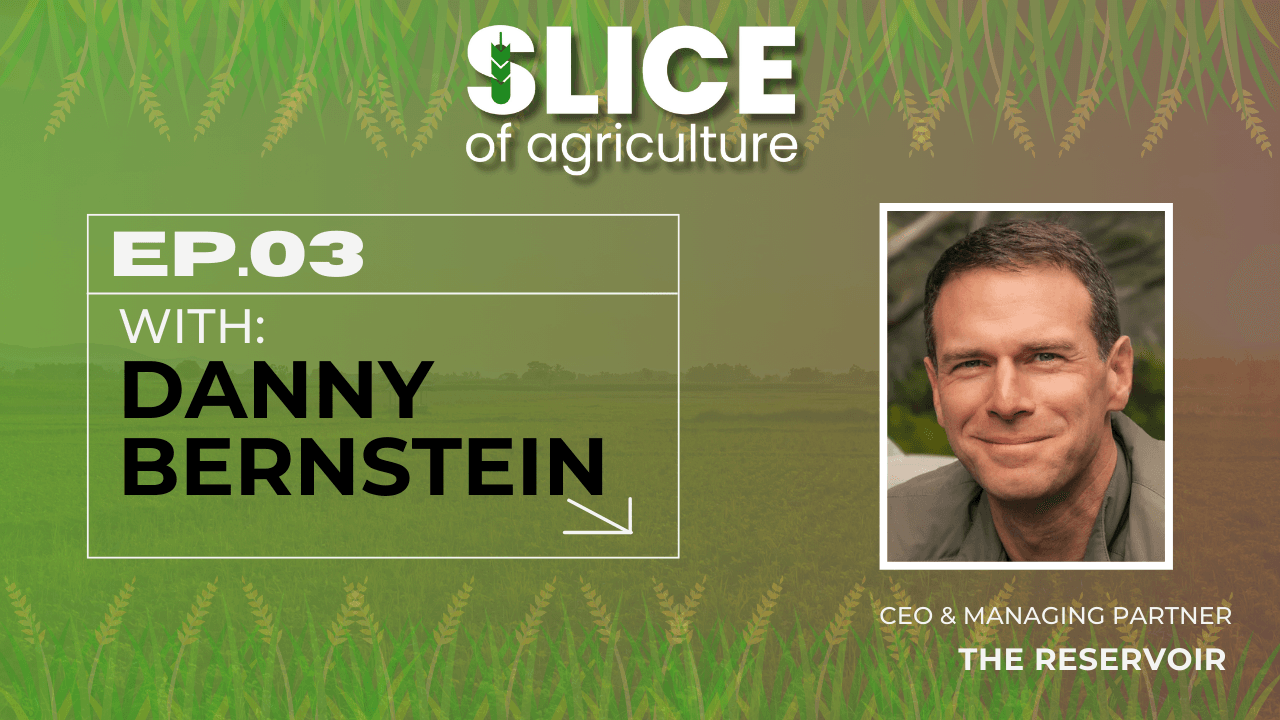
#3 - Danny Bernstein, CEO & Managing Partner at The Reservoir

Slice of Agriculture Team
04/07/2025


Guest
In Episode #3 of Slice of Agriculture our guest is:
Danny Bernstein, CEO & Managing Partner at The Reservoir.
Listen to the full episode to learn about:
- The Reservoir's Mission: A venture capital firm dedicated to revolutionizing AgTech through robotics and AI.
- Key Investments: Reservoir Ventures focuses on autonomy, precision agriculture, and AI-driven farm solutions.
- Challenges in Agriculture: Labor shortages and automation gaps in harvesting processes.
- Insights from the Netherlands: Lessons from a country where agriculture is a first-class industry.
- Future of AI in AgTech: Adapting existing AI frameworks for farm robotics and automation.
Watch
Listen
Read More
The Birth of The Reservoir
Danny Bernstein, CEO & Managing Partner at The Reservoir, has had a remarkable journey in technology and innovation. After selling his company to Google and spending a decade there, he realized that while industries like cybersecurity and fintech were saturated with tech solutions, agriculture remained largely untapped. Recognizing the massive economic and financial inequities in rural markets, Bernstein saw an opportunity to transform the industry through technology.
His vision led to the creation of The Reservoir, an early-stage venture capital firm focused on AgTech. The primary mission? To de-risk agricultural technology investments by fostering innovation, with an emphasis on robotics, automation, and precision agriculture.
Innovative Investments and the Reservoir Incubator
The Reservoir has already made significant investments, with a strong emphasis on building a dedicated incubator—Reservoir Farms. Unlike traditional startup incubators, this one is purpose-built for AgTech, integrating a working farm with a robotics lab.
Bernstein points out that while there are over 7,000 startup incubators worldwide, none effectively combine farming with cutting-edge robotics. This unique model aims to accelerate agricultural automation, particularly in labor-intensive sectors like harvesting.
Reservoir Ventures has also invested in several pioneering companies, including:
- FarmNG: An autonomy platform designed for agricultural applications.
- Software solutions: Focused on optimizing produce supply chains and water management.
- Precision technology: Targeting fire detection and prevention in agricultural areas.
Tackling Labor Shortages with Robotics
Labor remains one of the biggest challenges in agriculture. In California alone, the agricultural market is valued at $55 billion, with $16 billion spent on labor—most of it going toward harvesting. Yet, unlike large-scale crops like nuts that use shakers, most fruits and vegetables still require manual labor.
Bernstein highlights that 99% of micronutrient-rich crops—like strawberries, apples, and asparagus—are harvested manually. The rising cost of labor is making it increasingly difficult to grow these crops in the U.S., opening the door for robotics to play a transformative role. Companies like B-WISE, which has raised over $100 million for its robotic beekeeping service, exemplify this shift towards farm automation.
Lessons from the Netherlands: A Model for U.S. Agriculture
During a recent trip to the Netherlands, Bernstein observed key differences in how agriculture is treated as a first-class industry. Unlike the U.S., where sectors like technology and entertainment dominate, Dutch agricultural infrastructure is modern, well-maintained, and deeply integrated with public-private partnerships.